An SO-50 pass is about to start. Ten, fifteen minutes with the satellite above the horizon, all the time we get. I switch on the radio, tune the Doppler, and what reaches the speaker is not a conversation: it is a flood of callsigns, one on top of another, filling the only channel there is. The minutes go by. Not a single complete QSO. The pass ends, and I am left with the same question as always: was it worth it?
I am writing this with indignation and, I admit, some despondency. FM satellites are probably the best way into space-based amateur radio. We are wasting it.
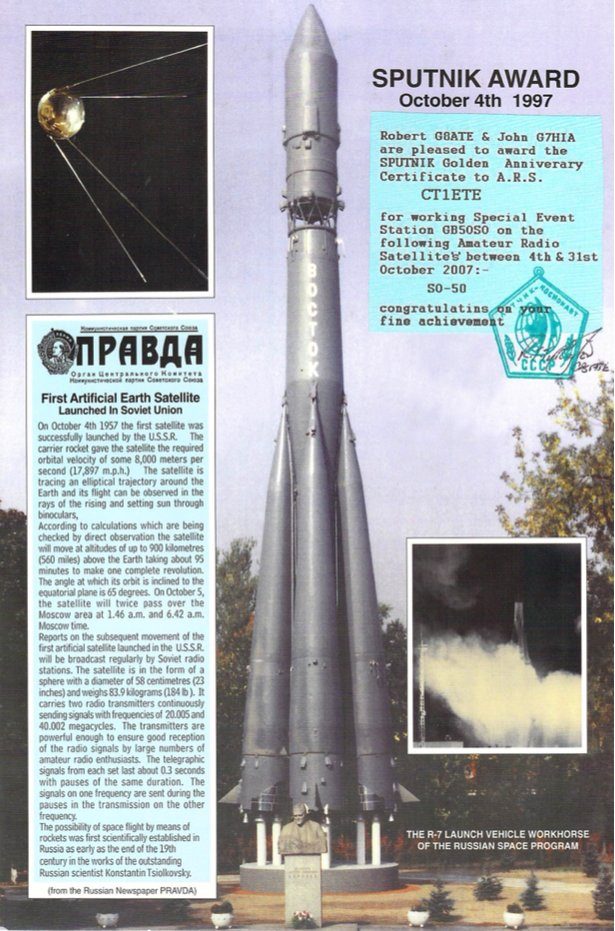
Sputnik Award, 2007: contacts with special event station GB50SO via SO-50.
One channel, one QSO at a time
The principle is so simple that it hurts to remind you of it: an FM satellite is a repeater with a single channel. Only one station can be heard at a time. Two stations transmitting together do not add up: they cancel each other out. Whoever calls over a QSO in progress does not improve their chances of a contact. They ruin the contact of whoever was communicating and, along the way, their own.
Respecting a QSO in progress is not an optional courtesy. It is the condition for the system to work at all. And yet, all it takes is one station releasing the PTT for three or four others to start calling straight away, without even waiting for the conversation to end.
Who are you, and who are you talking to?
Another classic. One station calls CQ and gives its callsign. Another answers with just its own callsign. And I wonder, like everyone else listening:
- is it answering the station that called CQ?
- is it saying it can reach the satellite?
- is it calling someone in particular?
- is it also calling CQ?
Nobody knows. And the convention exists precisely to avoid this: whoever answers a station says “AAAAAA de BBBBBB grid” (the callsign of the one calling, then their own, finishing with the grid locator) and waits for the reply. Three words, two seconds of antenna time, and everyone listening understands who is talking to whom. Without it, what comes out is noise with callsigns.
And right after, as if rehearsed, five stations jump in to interrupt what could have been a QSO.
Four characters are enough
One thing that irritates me in a very concrete way: European stations giving their locator with six characters. For the VUCC award only the first four positions of the grid locator count. So why say all six? Every extra letter is satellite time lost. On a channel shared by dozens of stations, with a pass of a little over ten minutes, every second is gold. In my case, “IN51” is enough. The rest is vanity, or habit, and either way it costs the group. And I have been guilty of it myself, so I know what I am talking about.
Stations that transmit but cannot hear
There is one more problem, and perhaps it is the worst: stations that transmit but cannot hear properly. They are reaching the satellite with a strong signal, but they do not hear the downlink, or do not hear it well, so they do not know the channel is busy. The result: they transmit on top of everyone without realising, and cause an outright blackout for whoever was trying to use the satellite.
Listening before transmitting is not a technical detail: it is the foundation of any radio operation. Whoever cannot hear the satellite should not be transmitting to it. If you cannot hear, do not transmit.
How it is done properly
What hurts most is knowing this is not inevitable. I have watched some YouTube videos of operators from other latitudes, and the experience is completely different. They wait for their turn. They listen. Whoever calls gives the callsign once or twice and goes quiet. Whoever answers uses the right format. The exchange is short, the QSO is closed, and the next one comes in. In a ten to fifteen minute pass, many well-made contacts are made, and everyone goes away satisfied, including those who waited for their turn.
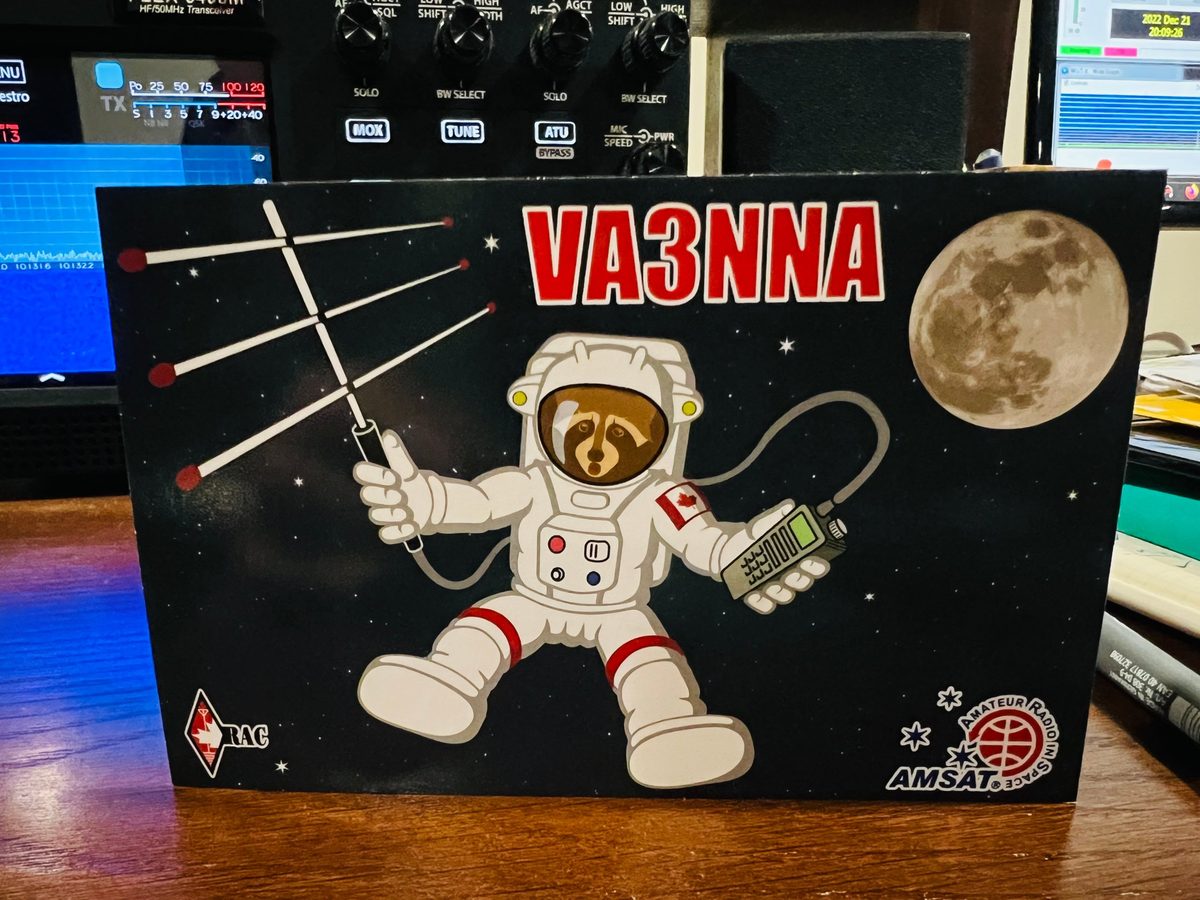
A QSL card from VA3NNA (Canada). A handheld and a Yagi are enough for satellites.
It is discipline, and it costs nothing. It is the same discipline that has made it possible, from the beginning, to share a resource as scarce as a satellite with dozens of stations at the same time.
The minimum I would like to see happen
In six points, what should be common practice:
- Listen first. If there is a QSO in progress, wait for it to end.
- Call sparingly. One call, the callsign, and silence.
- Answer in the right format: “AAAAAA de BBBBBB, grid”, and wait.
- Exchange only the essentials: callsign and a four-character locator.
- If you cannot hear the satellite, do not transmit. Fix the Doppler, the antenna, the receive frequency first.
- Close the QSO and free the channel. There are others waiting.
It is not asking much. It is what separates a pass well used from several wasted minutes. And if each of us does our part, FM satellites go back to being what they always promised to be: a place where it is possible to do radio.
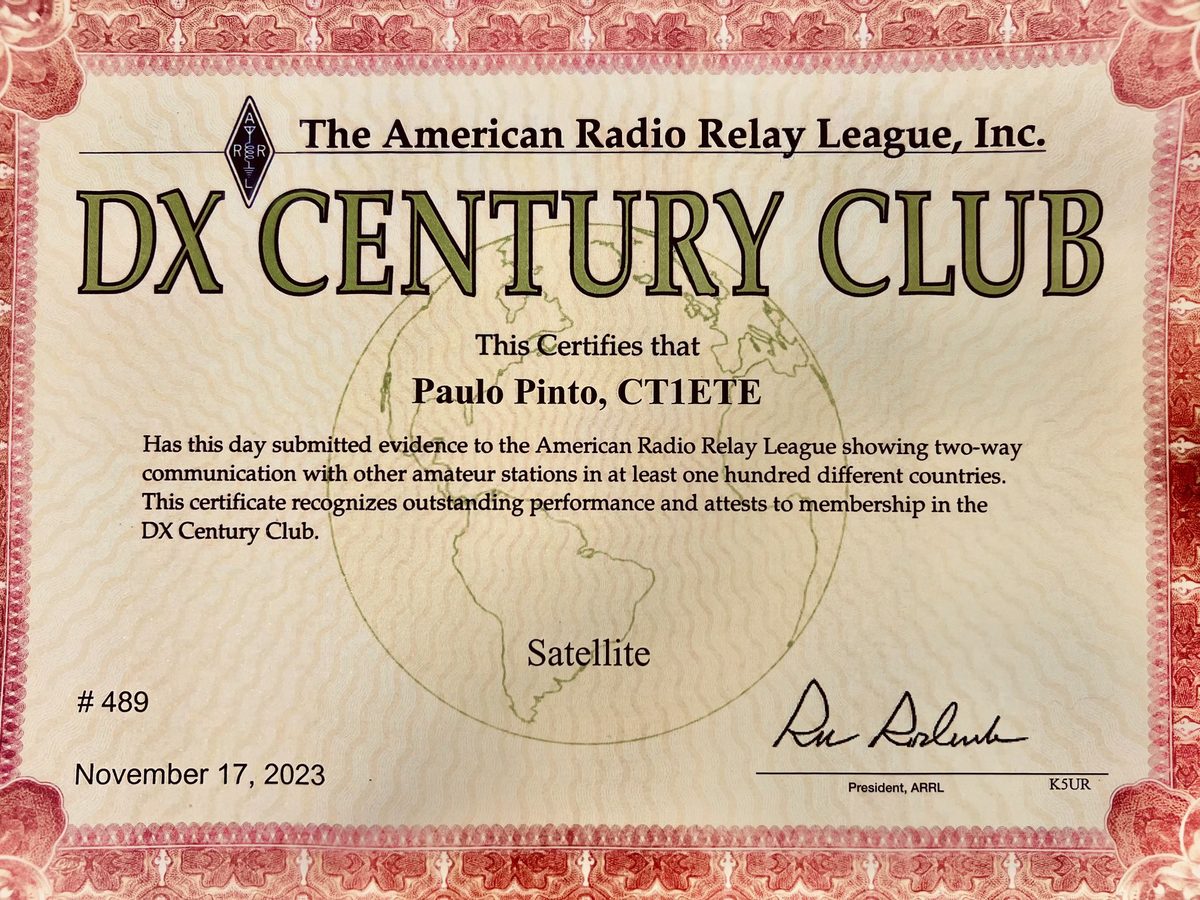
DXCC via satellite, certificate no. 489.
Oh! And by the way, the satellite is not only yours. Leave room for others to call too!